I knew that the Gorge Trail would close soon for the season soon, so I decided to venture down from the Upper Park in late October.
[Note: Do NOT enter the Gorge Trail in winter! See why at the end of this post.]
It's been years since I walked the full length of the Gorge Trail. A bothersome hip has set limits on how far I'll go on one of my frequent walks in the woods. I mostly have kept my rambles at Treman centered around the Upper Park.
That's why I couldn't recall just where this long, stone staircase is. Laborers from the Civil Conservation Corps (CCC) camp in the park constructed it in the 1930s, as shown in these photographs.
[Note: Do NOT enter the Gorge Trail in winter! See why at the end of this post.]
It's been years since I walked the full length of the Gorge Trail. A bothersome hip has set limits on how far I'll go on one of my frequent walks in the woods. I mostly have kept my rambles at Treman centered around the Upper Park.
That's why I couldn't recall just where this long, stone staircase is. Laborers from the Civil Conservation Corps (CCC) camp in the park constructed it in the 1930s, as shown in these photographs.
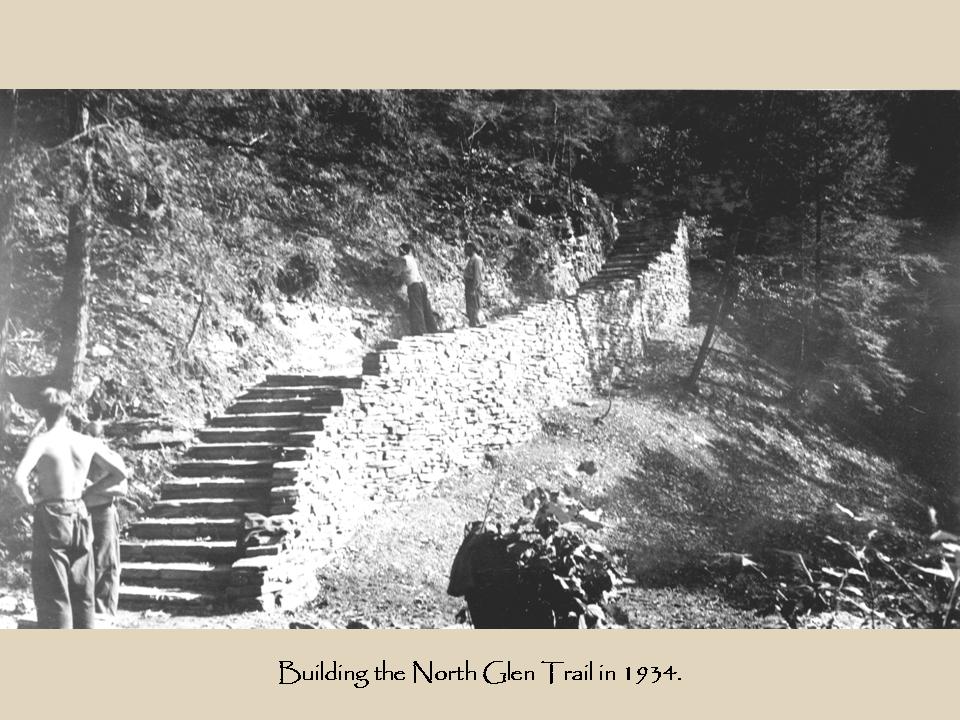
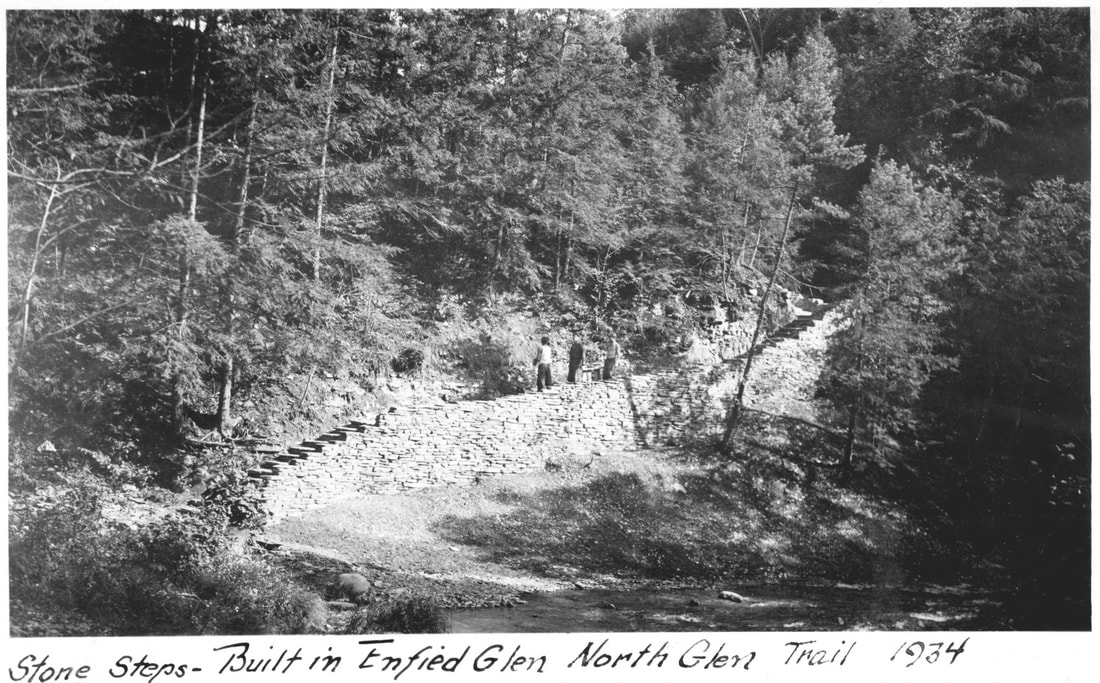
Josh Teeter, the director of environmental education in the Finger Lakes State Parks, reminded me some time ago that it is halfway down the Gorge Trail. So, I decided to go find it, heading down through the rocky Upper Gorge into the wooded canyon below.
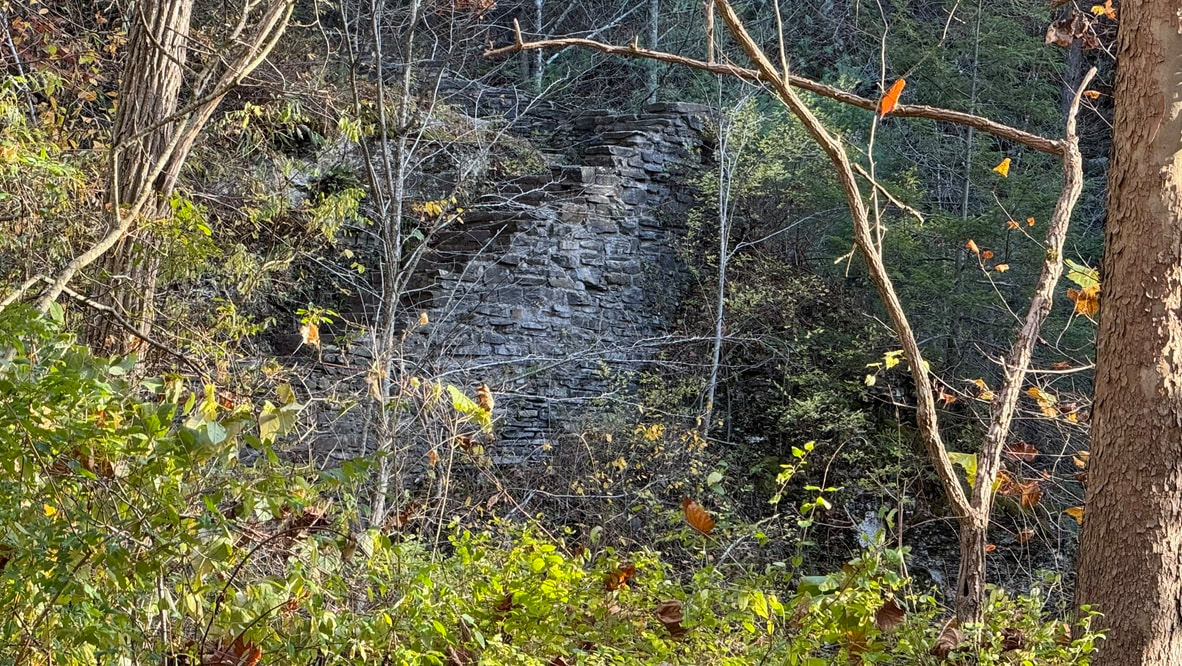
And there it was, a short walk past the mile marker sign; just where it was when those CCC young men built it in1934. It's a long, impressive stone stairway constructed by hand a mile back in the woods.
Though it's a mile back along the Gorge Trail (or the "North Glen Trail," as it appears to have been known as in the 1930s), the park is much longer than it is wide. As "Jim" remarked in the comments below, the masons likely were able to get much closer to the location of the staircase via a service road that connects to the Rim Trail, . So they woudn't actually have had to haul materials a mile back into the woods. Nonetheless, it clearly was quite a project, and itt's another monument to the hard work and achievements of those young men about 90 years ago.
Though it's a mile back along the Gorge Trail (or the "North Glen Trail," as it appears to have been known as in the 1930s), the park is much longer than it is wide. As "Jim" remarked in the comments below, the masons likely were able to get much closer to the location of the staircase via a service road that connects to the Rim Trail, . So they woudn't actually have had to haul materials a mile back into the woods. Nonetheless, it clearly was quite a project, and itt's another monument to the hard work and achievements of those young men about 90 years ago.
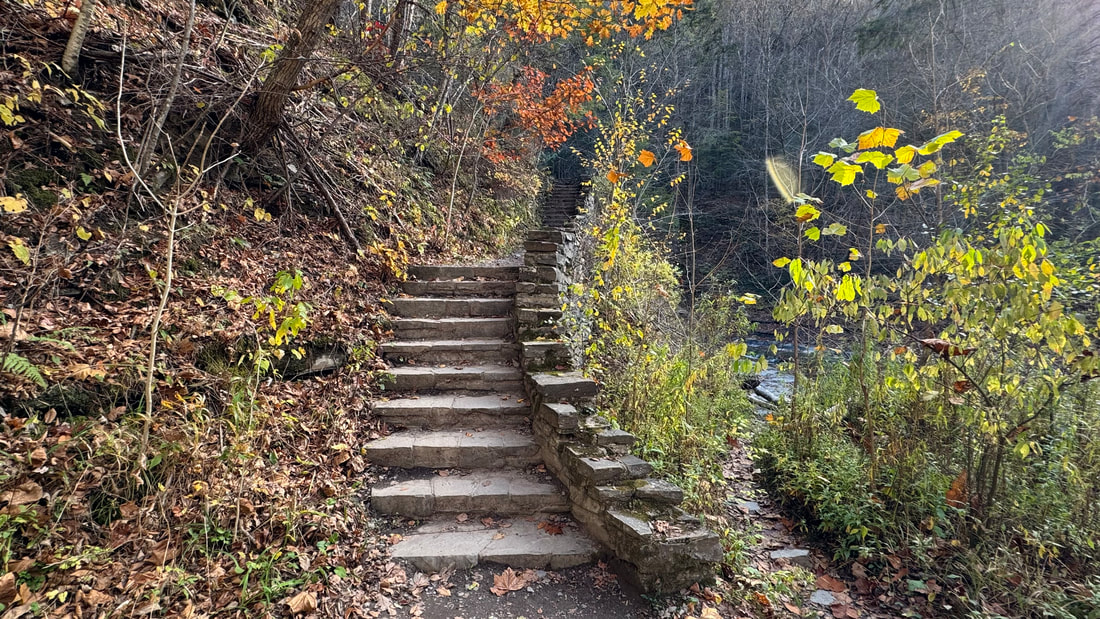
We shouldn’t give all the credit, however, to the CCC for our wonderful trail masonry. Much of it was built by park staff in the 1920s, especially in the Upper Gorge. The 1930s CCC crews were supervised by park masons. Furthermore, the stairs, bridges, and walls are not static. In the face of the rigors of gorge ice, rockslides, floods, and the pounding of millions of feet, they've needed maintenance and repair by trail crews for the century since.
~Tony Ingrahan, Board President
Friends of Robert H. Treman State Park
NOTE: Do NOT enter the Gorge Trail in winter! Extreme ice formations and the danger of rockfalls caused by freezing and thawing on the cliffs make it very dangerous, sometimes resulting in fatalities to poeple who ignore this, and risk to rescuers.
You must wait until the Gorge Trail is reopened in the spring, AFTER a process called "scaling" has taken place, which involves staff removing winter-loosened rock from cliffs above the trail. Watch a video about "scaling" the high cliffs in the Upper Gorge.
~Tony Ingrahan, Board President
Friends of Robert H. Treman State Park
NOTE: Do NOT enter the Gorge Trail in winter! Extreme ice formations and the danger of rockfalls caused by freezing and thawing on the cliffs make it very dangerous, sometimes resulting in fatalities to poeple who ignore this, and risk to rescuers.
You must wait until the Gorge Trail is reopened in the spring, AFTER a process called "scaling" has taken place, which involves staff removing winter-loosened rock from cliffs above the trail. Watch a video about "scaling" the high cliffs in the Upper Gorge.
 RSS Feed